
Online Questions - Valid Practice C_THR81_2505 Exam Dumps Test Questions
100% Real C_THR81_2505 dumps - Brilliant C_THR81_2505 Exam Questions PDF
SAP C_THR81_2505 Exam Syllabus Topics:
| Topic | Details |
|---|---|
| Topic 1 |
|
| Topic 2 |
|
| Topic 3 |
|
| Topic 4 |
|
NEW QUESTION # 19
Your client is live with the employee transfer process in the production instance. The workflow shown in the screenshot is triggered when an employee transfer is initiated.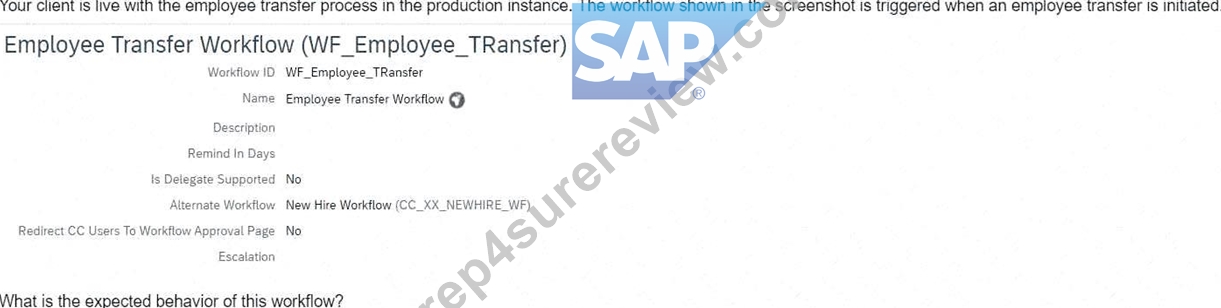
What is the expected behavior of this workflow?
- A. The initiator of the employee transfer process is given an option to choose New Hire Workflow as an alternate workflow to WF_Employee_Transfer.
- B. An approver can automatically reroute this request to another employee during vacation.
- C. The alternate workflow is used when there is a future-dated record entered for the employee.
- D. If an approver does NOT take any action for 3 days, a reminder notification is sent by the system.
Answer: C
Explanation:
In the scenario where an employee transfer process is initiated, and a workflow is triggered, the system behavior is as follows:
* Alternate Workflow Usage: If there is a future-dated record entered for the employee, the system utilizes the alternate workflow. This mechanism ensures that the appropriate workflow is applied based on the effective date of the transaction, allowing for accurate processing of future-dated changes.
This functionality is designed to handle scenarios where actions need to be taken in advance, ensuring that the system processes the correct workflow when the future-dated record becomes effective.
NEW QUESTION # 20
Based on the screenshot below, can you identify any errors on the definition of the business rule to Default Position Attributes? Note: There are 2 correct answers to this question.
- A. The Parent Position field should NOT be included in the business rule.
- B. The workflow configuration should NOT be included in the business rule.
- C. The Company field should NOT be included in the business rule.
- D. The FTE field should be derived from the business rule to Calculate FTE based on Standard Hours.
Answer: A,D
Explanation:
* C. The Parent Position field should NOT be included in the business rule:
* The Parent Position field is typically derived automatically based on position hierarchy and does not require explicit inclusion in a business rule for defaulting position attributes.
* D. The FTE field should be derived from the business rule to Calculate FTE based on Standard Hours:
* The FTE (Full-Time Equivalent) value should be calculated using a dedicated rule that accounts for standard hours, rather than being directly included in a defaulting rule.
Including these fields inappropriately can lead to data inconsistencies or rule execution issues.
NEW QUESTION # 21
Which of the following processes in Position Management are controlled from Position Management Settings?
Note: There are 3 correct answers to this question.
- A. Follow Up Activity in Position
- B. To Be Hired Status Adaptation
- C. Move Position with Supervisor on Job Information change
- D. Automated Daily Hierarchy Adaptation
- E. Synchronize Position Matrix Relationships to Job Relationships of Incumbents
Answer: A,B,D
Explanation:
The following processes in Position Management are controlled from the Position Management Settings:
* Follow Up Activity in Position: Allows configuration of follow-up actions such as automatically adjusting positions after specific events (e.g., vacancy creation).
* Automated Daily Hierarchy Adaptation: Ensures daily updates to the position hierarchy based on changes to positions or organizational relationships.
* To Be Hired Status Adaptation: Automatically adjusts the "To Be Hired" status of positions based on certain conditions or events.These settings streamline position management and help maintain accurate organizational structures.
NEW QUESTION # 22
You want the Timezone field to be pre-populated when the location record is changed in Job Info. How do you configure this?
- A. Base Object: Location; Assigned to Timezone field as onSave
- B. Base Object: Location: Assigned to Timezone field as onChange
- C. Base Object: Job Information; Assigned to Timezone field as onChange
- D. Base Object: Job Information; Assigned to Location field as onChange
Answer: D
Explanation:
To pre-populate the Timezone field when the location record is changed in Job Information, you need to configure the association as follows:
Base Object: Job Information
Trigger Event: Assigned to the Location field with the event set to onChange.
This configuration ensures that whenever the Location field is updated in Job Information, the system triggers the logic to update and pre-populate the Timezone field based on the associated Location. The onChange event drives this functionality.
NEW QUESTION # 23
How do you trigger a business rule to populate the Standard Hours field from Legal Entity records in the Add New Employee wizard?
- A. Event Type: onChange; Base Object: Employee Information
- B. Event Type: onSave: Base Object: Legal Entity
- C. Event Type: onEdit; Base Object: Employee Information
- D. Event Type: onInit; Base Object: Standard Hours
Answer: D
Explanation:
To populate the Standard Hours field from Legal Entity records in the Add New Employee wizard, the business rule should be configured with:
Event Type: onInit
This event triggers the rule during the initialization phase of the Add New Employee wizard.
Base Object: Standard Hours
The rule applies to the Standard Hours field, pulling data from the Legal Entity record.
Other event types such as onChange, onEdit, or onSave are not appropriate for pre-populating fields during the Add New Employee process.
NEW QUESTION # 24
How do you create country-specific fields for the Legal Entity object?
- A. As an HRIS element in the Corporate Data Model with a composite association to the Legal Entity object
- B. As a generic object with a Valid When association to the Legal Entity object
- C. As a generic object with a composite association to the Legal Entity object
- D. As an HRIS element in the Country Specific Field for Corporate Data Model with a Valid When association to the Legal Entity object
Answer: D
Explanation:
To create country-specific fields for the Legal Entity object in SAP SuccessFactors Employee Central, you should define these fields as an HRIS element within the Country-Specific Field section of the Corporate Data Model. This approach allows the system to manage country-specific attributes effectively. The 'Valid When' association is utilized to ensure that these fields are applicable only when certain conditions, such as the country of registration, are met. This configuration ensures that the Legal Entity object contains fields relevant to specific countries, facilitating accurate data management and compliance with local regulations.
NEW QUESTION # 25
Which condition must be used for the jobinfo_FTE_Comp rule?
- A. Option D
- B. Option A
- C. Option B
- D. Option C
Answer: A
Explanation:
For the Jobinfo_FTE_Comp rule, the correct condition to use is Option D. This ensures that the system evaluates changes in FTE values and event reasons to calculate and adjust compensation data accordingly. The precise conditions are necessary to maintain consistency in how the rule is applied across various HR scenarios.
Scenario 1: HR Transaction Rules
NEW QUESTION # 26
What actions can you initiate from the Position Org chart? Note: There are 3 correct answers to this question.
- A. Nominate a successor for a position
- B. Create a job requisition for a vacant position
- C. Add a lower-level position
- D. Mass copy positions
- E. Run a mass change to update positions
Answer: B,C,D
Explanation:
From the Position Org Chart in SAP SuccessFactors Employee Central, users can initiate the following actions:
A . Add a lower-level position:
Users can create subordinate positions directly within the hierarchy to reflect organizational reporting structures.
C . Create a job requisition for a vacant position:
A job requisition can be initiated for positions marked as vacant, streamlining the hiring process by linking positions to recruiting functionalities.
E . Mass copy positions:
This action allows for the duplication of multiple positions, facilitating quick setup of similar roles across the organization.
These features enhance the efficiency of managing the organizational structure and workforce planning.
NEW QUESTION # 27
The HR admin has to change the salary of an employee, which will trigger a workflow for the employee's manager. The employee's manager should be able to edit the transaction if the proposed amount is NOT correct.
Where in the workflow do you need to define this?
Refer to the screenshot to answer the question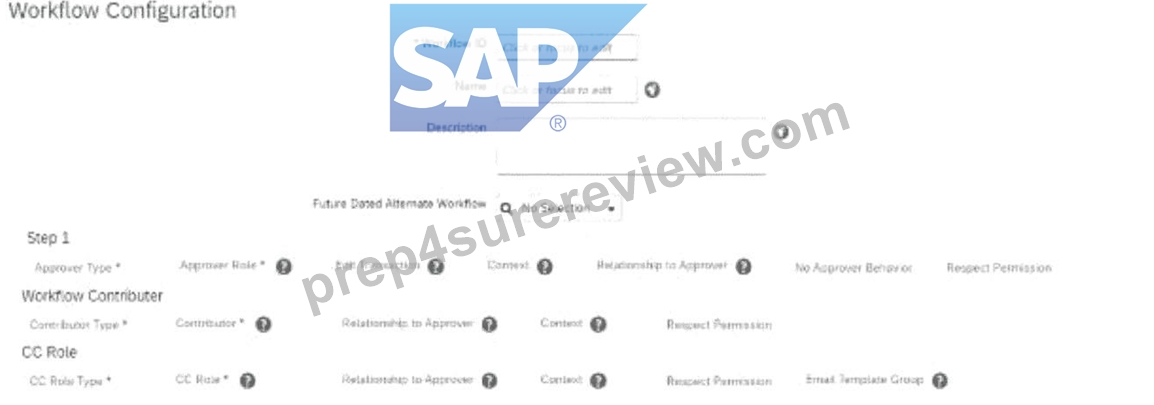
- A. Edit Transaction
- B. Context
- C. Respect Permission
- D. No Approver Behavior
Answer: A
Explanation:
To allow the employee's manager to edit a transaction in a workflow if the proposed salary change is incorrect, you must configure the "Edit Transaction" setting in the workflow.
* The "Edit Transaction" option is part of the workflow configuration in Step 1 (as shown in the screenshot).
* When enabled, it allows the approver (in this case, the manager) to make adjustments to the transaction before approving it.
Scenario 2: Approvals for Self-Service
NEW QUESTION # 28
What must be done to ensure that you can use a custom generic (MDF) object for Employee Self- Service?
Note: There are 2 correct answers to this question.
- A. Set the externalCode field to Data Type = User.
- B. Create a Valid When association for the object.
- C. Set the externalName field to Data Type = User.
- D. Create one configuration UI for the object.
Answer: A,D
Explanation:
To enable a custom Generic (MDF) object for Employee Self-Service (ESS) in SAP SuccessFactors Employee Central, the following configurations are necessary:
* C. Create one configuration UI for the object.
* A Configuration UI (User Interface) must be created for the MDF object to define how users will interact with it. This UI facilitates data entry and management within the ESS framework.
SAP Learning Hub
* D. Set the externalCode field to Data Type = User.
* The externalCode field should be set to the 'User' data type. This configuration ensures that the object is associated with specific user records, enabling personalized data management within ESS.
SAP Learning Hub
Options A and B are not required for enabling a custom MDF object for Employee Self-Service:
* A. Set the externalName field to Data Type = User.
* The externalName field typically holds descriptive information and does not need to be set to the
'User' data type for ESS functionality.
* B. Create a Valid When association for the object.
* While associations can define relationships between objects, a 'Valid When' association is not a prerequisite for enabling ESS capabilities for a custom MDF object.
NEW QUESTION # 29
What are some of the position management application-specific rule scenarios? Note: There are 3 correct answers to this question.
- A. Update Rule for Mass Change Run
- B. Create Right to Return for Incumbent
- C. Trigger Rules to Calculate Full-Time Equivalent
- D. Trigger Rules for Off Cycle Event Batch
- E. Derive Job Requisition Template in Recruiting Integration
Answer: A,B,C
Explanation:
Application-specific rule scenarios in Position Management include:
A . Create Right to Return for Incumbent:
This rule supports the creation of a right-to-return record for an incumbent when a position-related action occurs, such as a temporary assignment.
B . Update Rule for Mass Change Run:
This rule automates updates during mass position changes, ensuring consistent application of business logic across multiple positions.
C . Trigger Rules to Calculate Full-Time Equivalent:
This rule calculates the FTE value based on position or job information attributes, ensuring accurate reporting and compliance.
These rules enhance the flexibility and functionality of position management processes.
NEW QUESTION # 30
Your customer needs to set up a workflow to direct approval processes to the head of a business unit.
Which approver type do you use?
- A. Dynamic Role
- B. Dynamic Group
- C. Role
- D. Manager
Answer: A
Explanation:
To direct approval processes to the head of a business unit, you use a Dynamic Role. This approver type allows you to dynamically assign approval tasks based on relationships such as the head of a specific organizational structure.
A Manager approver type refers to direct line managers, which is different from business unit heads.
Dynamic Groups and Roles do not specifically address the dynamic nature of organizational roles like a business unit head.
NEW QUESTION # 31
You have updated several position departments using Import and Export data, but the incumbent's data still shows the previous information for the department hris-field.
What are some possible causes for this data inconsistency? Note: There are 2 correct answers to this question.
- A. The technicalParameters column with a value of SYNC has NOT been included in the import file.
- B. The business rule to sync data changes sets the Position Department to be equal to Job Information.
Department. - C. The technicalParameters value has NOT been set to SYNC in the position records.
- D. The business rule to sync data changes sets the Job Information.Department to be equal to Job Information.Position.Department.
Answer: A,B
Explanation:
* B. The technicalParameters column with a value of SYNC has NOT been included in the import file:
* When importing position data, the technicalParameters column with the value "SYNC" must be included to ensure that changes to position attributes are synchronized to the incumbent's data.
* C. The business rule to sync data changes sets the Position Department to be equal to Job Information.Department:
* If the rule is incorrectly configured, the department field on the incumbent's job information may not update as expected. The correct configuration should align the position department with the incumbent's job information.
These factors contribute to discrepancies between position and incumbent data.
NEW QUESTION # 32
How does the system connect the country-relevant Legal Entity fields to a country? Note: There are 2 correct answers to this question.
- A. By association, using the countryOfRegistration.code in the Source Filter Criteria
- B. By association, using the 3-letter ISO code of the country in the Condition Values
- C. By association, using the countryOfRegistration.code in the Condition
- D. By association, using the 3-letter ISO code of the country in the Destination Filter Criteria
Answer: C,D
Explanation:
The system connects country-relevant Legal Entity fields to a specific country through associations that utilize the countryOfRegistration.code. This is achieved by setting the countryOfRegistration.code in the Condition and using the 3-letter ISO code of the country in the Destination Filter Criteria. By configuring these associations, the system can dynamically display or hide fields based on the country's ISO code, ensuring that only relevant fields are presented for each Legal Entity.
NEW QUESTION # 33
What are some SAP recommended guiding principles to achieve clean core operations? Note: There are 3 correct answers to this question.
- A. Establish regular housekeeping tasks and procedures.
- B. Establish an organizational structure, technical foundation, and transformation methodology for clean core.
- C. Integrate clean core practices in the end-to-end value process chain.
- D. Establish release management.
- E. Define roles and responsibilities as part of a process transformation office.
Answer: B,C,E
Explanation:
SAP recommends the following guiding principles to maintain clean core operations:
Integrate Clean Core Practices in End-to-End Processes: Embed clean core strategies throughout the value chain for consistency.
Define Roles and Responsibilities: Establish clear accountability for clean core implementation via a process transformation office.
Organizational and Technical Foundation: Develop a robust framework, including technical structures and methodologies, to drive clean core adherence.
Other activities like release management and regular housekeeping are operational best practices but not core guiding principles.
Scenario 1: HR Transaction Rules
NEW QUESTION # 34
How do you set the event date in Compensation Information for the jobinfo_FTE_Comp cross-entity rule?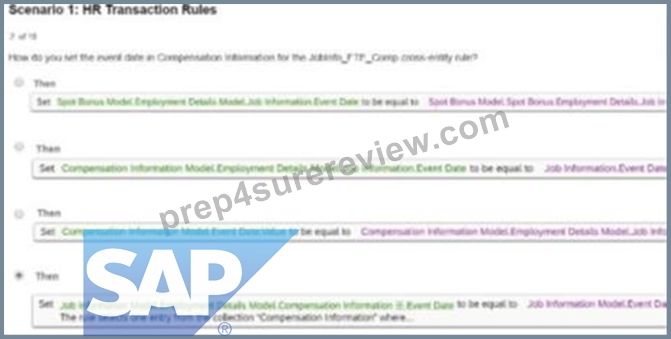
- A. Option D
- B. Option A
- C. Option B
- D. Option C
Answer: A
Explanation:
To set the event date in Compensation Information for the Jobinfo_FTE_Comp cross-entity rule, Option D is the correct method. The approach ensures that the Event Date field in the Compensation Information section aligns with the Event Date in Job Information. This synchronization is crucial for maintaining consistency in effective dates across entities during HR transactions.
Scenario 1: HR Transaction Rules
NEW QUESTION # 35
Which of the following can you use to explore released APIs?
- A. SAP Application Interface Framework
- B. SAP Business Accelerator Hub
- C. SAP Integration Suite
Answer: B
Explanation:
The SAP Business Accelerator Hub is the primary platform for exploring released APIs.
* It provides a central repository where developers can browse, test, and integrate various APIs across SAP solutions.
* The hub is designed for simplifying API access and ensuring integration consistency in SAP environments.Other options like SAP Application Interface Framework and SAP Integration Suite focus on integration but do not primarily serve as a platform for exploring APIs.
NEW QUESTION # 36
Which pre-delivered objects are configured in the Corporate Data Model? Note: There are 3 correct answers to this question.
- A. Location
- B. Event reason
- C. Pay range
- D. Pay Calendar
- E. Cost center
Answer: A,B,C
NEW QUESTION # 37
This is a global customer and HR admins will be assigned based on legal entity. The HR admins should be getting approval workflows from their target population.
How can you define this in one workflow?
- A. Create a dynamic role for each legal entity and assign the Resolver as the head of the legal entity.
- B. Create a dynamic role using the Legal Entity filter and assign the Resolver type as dynamic group
- C. Create dynamic groups per each legal entity and add the necessary approver steps.
- D. Create permission groups for each legal entity and assign them to the HR admin role.
Answer: B
Explanation:
For a global customer where HR admins are assigned based on legal entities and need to receive approval workflows for their target population, you can configure the workflow as follows:
Create a Dynamic Role using the Legal Entity filter.
Assign the Resolver Type as a Dynamic Group to ensure the workflow automatically routes to the correct HR admin based on the legal entity.
This configuration avoids creating multiple static workflows and simplifies management by dynamically resolving approvers based on the legal entity.
Scenario 2: Approvals for Self-Service
NEW QUESTION # 38
Which of the following are examples of standard one-to-one associations? Note: There are 2 correct answers to this question.
- A. Pay Range to Legal Entity
- B. Location to Legal Entity
- C. Department to Division
- D. Location to Geozone
Answer: A,D
Explanation:
Standard one-to-one associations link objects in a parent-child relationship, where each instance of the parent object is associated with one instance of the child object. Examples include:
Location to Geozone: A location belongs to one specific geozone.
Pay Range to Legal Entity: A pay range is tied to a single legal entity.
Location to Legal Entity and Department to Division are examples of one-to-many associations.
NEW QUESTION # 39
Which condition must be used for the jobinfo_FTE_Comp rule?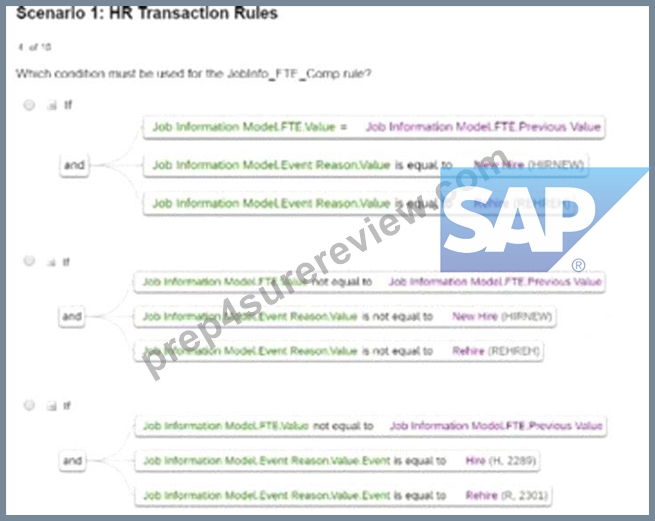
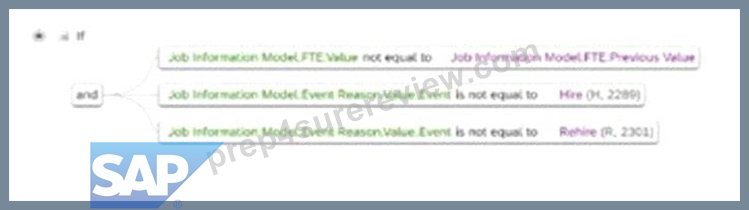
- A. Option D
- B. Option A
- C. Option B
- D. Option C
Answer: A
Explanation:
For the Jobinfo_FTE_Comp rule, the correct condition to use is Option D. This ensures that the system evaluates changes in FTE values and event reasons to calculate and adjust compensation data accordingly.
The precise conditions are necessary to maintain consistency in how the rule is applied across various HR scenarios.
Scenario 1: HR Transaction Rules
NEW QUESTION # 40
What is generic object foTranslation used for in SAP SuccessFactors Employee Central?
- A. To translate any generic object field labels in the instance
- B. To translate XML and MDF FO field labels
- C. To translate XML FO field labels
- D. To translate MDF FO field labels
Answer: D
NEW QUESTION # 41
How do you trigger a business rule to populate the Standard Hours field from Legal Entity records in the Add New Employee wizard?
- A. Event Type: onChange; Base Object: Employee Information
- B. Event Type: onSave: Base Object: Legal Entity
- C. Event Type: onEdit; Base Object: Employee Information
- D. Event Type: onInit; Base Object: Standard Hours
Answer: D
Explanation:
To populate the Standard Hours field from Legal Entity records in the Add New Employee wizard, the business rule should be configured with:
Event Type: onInit
This event triggers the rule during the initialization phase of the Add New Employee wizard.
Base Object: Standard Hours
The rule applies to the Standard Hours field, pulling data from the Legal Entity record.
Other event types such as onChange, onEdit, or onSave are not appropriate for pre-populating fields during the Add New Employee process.
NEW QUESTION # 42
......
C_THR81_2505 Exam PDF [2026] Tests Free Updated Today with Correct 86 Questions: https://dumpstorrent.prep4surereview.com/C_THR81_2505-latest-braindumps.html
