
Go to C-C4H56-2411 Questions - Try C-C4H56-2411 dumps pdf
Dumps Practice Exam Questions Study Guide for the C-C4H56-2411 Exam
NEW QUESTION # 14
What basic steps are required to create the warranties as described?
- A. Create a Registered Product for an organization. Maintain the Warranty field and then save.
- B. Create a Registered Product for a Customer Account. Maintain the Warranty field and then save.
- C. Copy an existing Warranty to a new Individual Customer, alter the conditions and then save.
- D. Warranties are automatically generated when a Registered Product is created.
Answer: D
NEW QUESTION # 15
Which action should an administrator take to get a system bug fixed within SAP Service Cloud Version 2?
- A. Create an incident
- B. Report an issue via case
- C. Send an e-mail to SAP Cloud Support
- D. Implement the provided hotfix number
Answer: A
NEW QUESTION # 16
When using autoflow rules, which of the following do you need to consider? Note: There are 3 correct answers to this question.
- A. Optimization from the back end is done automatically when too many autoflow rules exist.
- B. Conditions can be based on extension fields.
- C. Too many rules affect system performance.
- D. Autoflow rules must be assigned to the business role.
- E. Conditions can be based on standard fields.
Answer: B,C,E
NEW QUESTION # 17
What can you do with Agent Desktop in SAP Service Cloud Version 2? Note: There are 2 correct answers to this question.
- A. Create installed bases.
- B. Use a mashup to execute transactions in other SAP solutions.
- C. Create accounts and contacts.
- D. Assign products to existing accounts.
Answer: B,C
NEW QUESTION # 18
Which milestone can you use for service levels?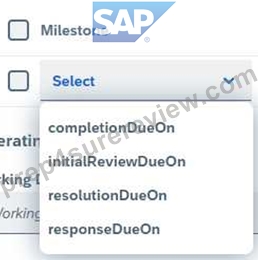
- A. Warranty validity
- B. Status
- C. Initial review date
- D. Created-on date
Answer: C
NEW QUESTION # 19
Which of the following objects can be replicated from SAP Service Cloud Version 2 to SAP S/4HANA? Note: There are 2 correct answers to this question.
- A. Products
- B. Contacts
- C. Service contracts
- D. Registered products
Answer: B,D
NEW QUESTION # 20
Where can you find existing cases in SAP Service Cloud Version 2? Note: There are 2 correct answers to this question.
- A. In the My Cases Summary card available in the home page
- B. In the cases settings view
- C. In the case worklist by choosing the Case app from the menu
- D. In the product page
Answer: A,C
NEW QUESTION # 21
Which of the following can you use to explore released APIs?
- A. SAP Business Accelerator Hub
- B. SAP Application Interface Framework
- C. SAP Integration Suite
Answer: A
Explanation:
The SAP Business Accelerator Hub is the primary tool for exploring released APIs for SAP solutions, including SAP Service Cloud V2. It provides a centralized repository to discover, test, and consume APIs. According to SAP documentation, "The SAP Business Accelerator Hub allows developers to explore and access released APIs for SAP cloud solutions." SAP Integration Suite (B) is used for integration but not for exploring APIs. SAP Application Interface Framework (C) is specific to SAP S/4HANA for interface management, not API exploration.
Reference:
SAP Help Portal: SAP Business Accelerator Hub
SAP Community: API Discovery in SAP Cloud Solutions
NEW QUESTION # 22
What functionality can you use to grant user access to an SAP S/4HANA transaction in SAP Service Cloud Version 2 as an administrator? Note: There are 2 correct answers to this question.
- A. Business flow
- B. Mashup
- C. Configure the relevant action
- D. Custom entity
Answer: B,C
NEW QUESTION # 23
What is one of the main uses for warranty management in SAP Service Cloud Version 2?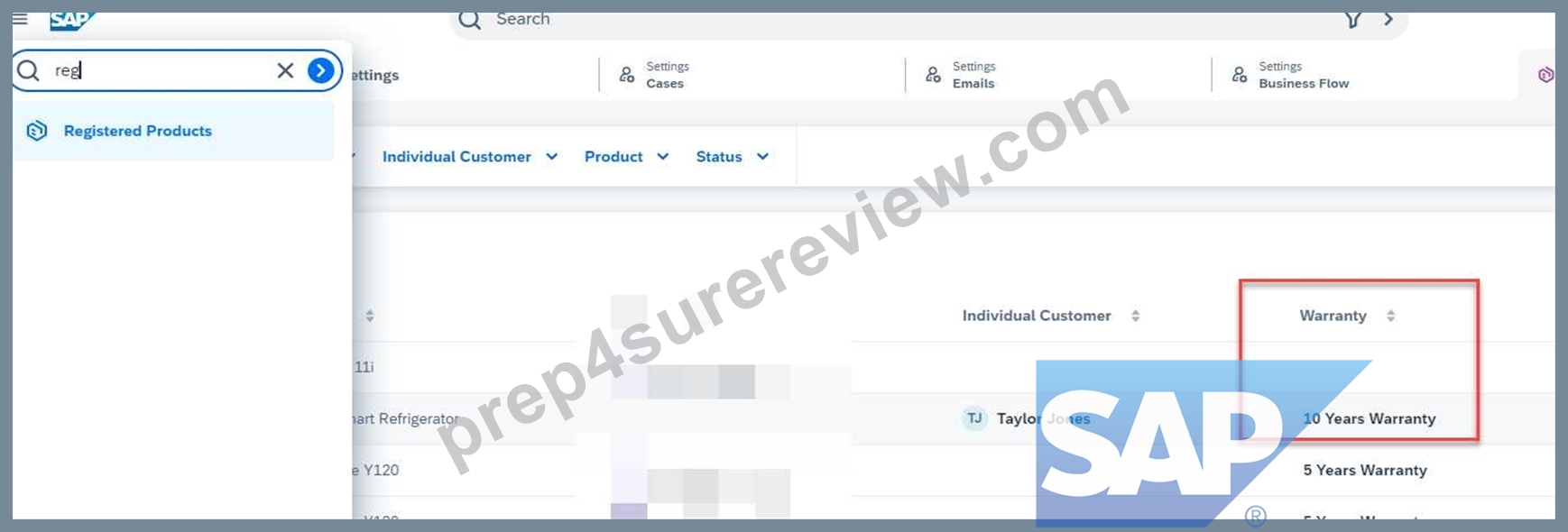
- A. The warranty is assigned to a registered product.
- B. Routing rules can be applied to warranties.
- C. The warranty is assigned to a contract.
- D. The system can be set up so that certain service levels are not covered.
Answer: A
NEW QUESTION # 24
Which objects are determined when you are using case routing in SAP Service Cloud Version 2? Note: There are 2 correct answers to this question.
- A. Employee
- B. Service team
- C. Service category
- D. Account
Answer: A,B
NEW QUESTION # 25
Which of the following are required to grant business user access? Note: There are 2 correct answers to this question.
- A. Employee
- B. Assignment to an organizational unit
- C. Access restriction
- D. User ID
Answer: A,D
NEW QUESTION # 26
You want to assign employees to multiple organizational units. Which action needs to be performed to achieve this?
- A. Acquire an additional license for the required add-on.
- B. Enable the Primary flag in the organization unit.
- C. Assign employees directly to different organizational objects.
- D. Assign the employee at company level.
Answer: C
NEW QUESTION # 27
Which of the following features can be used to tailor the user interface for the business? Note: There are 2 correct answers to this question.
- A. Homepage branding
- B. Language adaptation
- C. Content security policy
- D. Business role
Answer: A,B
Explanation:
To tailor the user interface in SAP Service Cloud V2, Homepage branding allows administrators to customize the look and feel of the homepage, including logos and color schemes, to align with corporate branding. Language adaptation enables the modification of field labels and texts to support different languages or business-specific terminology. According to SAP documentation, "Homepage branding and language adaptation are key features for customizing the user interface to meet business needs." Business role (B) controls access and permissions, not UI customization. Content security policy (C) is a security feature, not related to UI tailoring.
Reference:
SAP Help Portal: User Interface Customization in SAP Service Cloud V2
SAP Learning: UI Adaptation and Branding
NEW QUESTION # 28
Which actions are prerequisites for using registered products? Note: There are 2 correct answers to this question.
- A. Create an installed base
- B. Activate the service in the business role
- C. Create numeric ranges for customers
- D. Use existing customer records
Answer: A,D
Explanation:
To use registered products in SAP Service Cloud V2, using existing customer records is a prerequisite, as registered products must be associated with a customer (account or contact) to track ownership. Additionally, creating an installed base is required, as registered products are typically grouped within an installed base to manage customer assets. According to SAP documentation, "Registered products are linked to customer records and installed bases to enable service processes like case management." Creating numeric ranges for customers (C) is not relevant to registered products. Activating the service in the business role (D) is necessary for accessing features but is not a direct prerequisite for using registered products.
Reference:
SAP Help Portal: Registered Products in SAP Service Cloud V2
SAP Learning: Product and Installed Base Setup
NEW QUESTION # 29
Which actions are necessary to use installed bases in cases? Note: There are 2 correct answers to this question.
- A. At least one registered product must be assigned to the installed base.
- B. A customer needs to be assigned to the installed base.
- C. The installed base must be set to active status.
- D. An active service contract must be added to the installed base.
Answer: B,D
NEW QUESTION # 30
Which master data is synchronized bidirectionally between SAP S/4HANA and SAP Service Cloud Version 2?
- A. Account
- B. Product
- C. Account hierarchy
- D. Employee
Answer: A
NEW QUESTION # 31
Which of the following are mandatory to maintain when you want to create a new business user? Note: There are 2 correct answers to this question.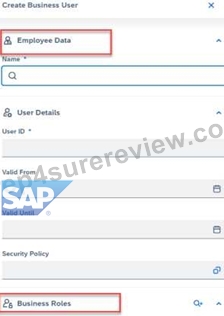
- A. Employee
- B. Organization
- C. Business role
- D. E-mail
Answer: A,C
NEW QUESTION # 32
Which of the following elements are mandatory to create a new product? Note: There are 2 correct answers to this question.
- A. Sales area data
- B. Product group
- C. Price
- D. Unit of measure
Answer: B,D
Explanation:
When creating a new product in SAP Service Cloud V2, the Product group is mandatory to categorize the product within the system. The Unit of measure is also required to define how the product is quantified (e.g., pieces, kilograms). According to SAP documentation, "Creating a new product requires specifying the Product Group and Unit of Measure as mandatory fields." Price (B) is optional, as pricing may not apply to all products. Sales area data (C) is relevant for sales processes, not mandatory for product creation in Service Cloud.
Reference:
SAP Help Portal: Product Creation in SAP Service Cloud V2
SAP Community: Product Master Data Setup
NEW QUESTION # 33
Which objects can you use to route a case to an employee?
- A. Autoflow
- B. Mashup
- C. Input fields in the Case Designer
- D. Source
Answer: D
Explanation:
In SAP Service Cloud V2, the Source of a case (e.g., email, phone, social media) can be used as a condition to route a case to an employee. According to SAP documentation, "You can configure the rules to determine the Service Level for a certain ticket depending on several parameters like Ticket Type, Service Category, Source, Channel ID etc." Source is a standard attribute in routing rules to determine the appropriate employee or team.
Mashup (A) is used for external integrations, not routing. Autoflow (B) automates actions but does not route cases to employees. Input fields in the Case Designer (C) collect data but are not used for routing.
Reference:
SAP Community: Service Level Agreement in SAP Cloud for Customer community.sap.com SAP Help Portal: Case Routing Rules Configuration
NEW QUESTION # 34
Which of the following API types does SAP recommend to achieve clean core integrations? Note: There are 2 correct answers to this question.
- A. OData
- B. IDoc
- C. RFC
- D. SOAP
Answer: A,D
Explanation:
For clean core integrations, SAP recommends using modern, standards-based APIs like SOAP and OData. These API types ensure interoperability, scalability, and alignment with SAP's clean core strategy, which emphasizes minimal customizations and standardized integrations. According to SAP documentation, "SAP recommends using OData and SOAP APIs for clean core integrations to maintain system extensibility and future-proofing." RFC (A) and IDoc (B) are legacy integration methods that do not align with the clean core approach due to their complexity and lack of flexibility.
Reference:
SAP Help Portal: Clean Core Integration Strategy
SAP Community: API Integration in SAP Cloud Solutions
NEW QUESTION # 35
Which of the following actions do you need to grant access to the relevant service objects? Note: There are 2 correct answers to this question.
- A. Set up the case designer with the assignment step employee
- B. Assign a business role to a user
- C. Assign a business role to an employee
- D. Assign a business role to a service organization
Answer: B,C
Explanation:
To grant access to service objects (e.g., cases) in SAP Service Cloud V2, administrators must assign a business role to a user to define their permissions for accessing specific objects. Similarly, assigning a business role to an employee ensures the employee has the necessary access rights linked to their user account. According to SAP documentation, "Access to service objects is granted by assigning business roles to users or employees." Assigning a business role to a service organization (B) is not a standard action, as roles are assigned to individuals. Setting up the case designer with the assignment step employee (D) is for case routing, not object access.
Reference:
SAP Help Portal: Business Role Assignment in SAP Service Cloud V2
SAP Learning: Access Management for Service Objects
NEW QUESTION # 36
......
Free SAP Certified Associate C-C4H56-2411 Exam Question: https://dumpstorrent.prep4surereview.com/C-C4H56-2411-latest-braindumps.html
