
2025 Easily pass NCA-6.10 Exam with our Dumps & PDF Test Engine
NCA-6.10 PDF Pass Leader, NCA-6.10 Latest Real Test
NEW QUESTION # 11
Which AOS component is responsible for monitoring and eliminating hots-pots within the cluster?
- A. Cerebro
- B. Controller Virtual Machine
- C. Chronos
- D. Acropolis Dynamic Scheduling
Answer: D
Explanation:
The correct answer isB. Acropolis Dynamic Scheduling (ADS).
Acropolis Dynamic Scheduling (ADS)is a core component in Nutanix AOS responsible for:
* Monitoring real-time resource utilization.
* Identifying hotspotssuch as CPU/memory/storage contention.
* Automatically initiatingVM migration (live)tobalance workloadsacross hosts in the cluster.
Clarification of Other Options:
* A. Cerebro:Responsible for replication, snapshots, and consistency.
* C. Chronos:Manages scheduling of distributed tasks (not resource balancing).
* D. CVM:Hosts the AOS services butdoes not perform workload balancing.
Official Reference:
* Nutanix Bible - Acropolis Dynamic Scheduling
* Nutanix AOS Architecture Guide
* Excerpt: "ADS monitors resource utilization across the cluster and performs live VM migrations to mitigate hotspots and balance performance."
NEW QUESTION # 12
When creating a new storage container, what is the default configuration for Compression?
- A. Post-process (60 minutes)
- B. Disabled
- C. Inline
- D. Post-process (15 minutes)
Answer: B
Explanation:
The correct answer isB. Disabled.
When creating a new storage container in Prism Element or Prism Central,compression is disabled by default. The administrator mustexplicitly enableone of the available compression options:
* Inline Compression
* Post-process Compression
If no compression type is selected, the container remains uncompressed.
UI Navigation Path:
Storage > Storage Containers > Create Container > Compression Settings
Clarifications:
* A (60 mins)andC (15 mins): Not standard default post-process intervals.
* D (Inline): Must be manually selected.
Official Reference:
* Nutanix Storage Administration Guide - Creating and Configuring Containers
* Excerpt: "Compression is disabled by default during container creation. Admins must select inline or post-process if desired."
NEW QUESTION # 13
Which is the default native Linux bridge in AHV?
- A. bridge0
- B. br0
- C. virbro
- D. vs0
Answer: B
Explanation:
The correct answer isA. br0.
InAHV (Acropolis Hypervisor),br0is thedefault native Linux bridgecreated on each hypervisor host. It is used for VM traffic and external communication. AHV leveragesOpen vSwitch (OVS)to manage virtual networking, but the bridge is exposed as br0 in the host's network configuration.
Key points:
* br0connects VM virtual NICs (vNICs) to the physical network via the host's uplinks.
* It is pre-configured during Foundation or cluster deployment.
* virbr0is typical in KVM environments but isnot usedin AHV.
Official Reference:
* Nutanix AHV Networking Guide
* Nutanix KB #2027 - AHV Host Networking
* Excerpt: "AHV uses br0 as the default bridge on the host, configured by Open vSwitch for guest VM networking."
NEW QUESTION # 14
An administrator wants to apply tags to licenses to simplify future renewals.
What interface would be used to complete this operation?
- A. Clusters in the Support Portal
- B. Prism Element Licensing
- C. Prism Central Licensing
- D. License Inventory in the Support Portal
Answer: C
NEW QUESTION # 15
An administrator needs to create a VM Template from an existing VM.
What is required for this action to be successful?
- A. Windows OS is installed.
- B. The VM is powered on.
- C. The VM is powered off.
- D. Sysprep or Cloud-init script.
Answer: C
Explanation:
To create a VM template from an existing VM in Nutanix, the VM must be powered off. This ensures that the template is consistent and does not include any transient data or activity from the VM. Once the VM is powered off, the administrator can use the Prism UI to take a snapshot and designate it as a template.
* A. Sysprep or Cloud-init script:These are optional for post-deployment configuration, not mandatory for creating a template.
* B. The VM is powered on:This is incorrect, as the VM must be powered off.
* C. Windows OS is installed:The OS type is irrelevant for creating a template.
* D. The VM is powered off:Correct, as creating a template requires the VM to be in a powered-off state.
References:
Nutanix AHV Administration Guide: Nutanix Documentation
Nutanix University Certification Content for NCP and NCM.
NEW QUESTION # 16
What is the purpose of the Recycle Bin?
- A. Keeps deleted VMs for 24 hours for recovery.
- B. Stores the OpLog's most recent deleted data in case of a CVM failure.
- C. Allows administrators to undo the last five actions.
- D. Centralizes the deleted data from the different VMs in the cluster.
Answer: A
NEW QUESTION # 17
When is deduplication recommended?
- A. Full clone VMs
- B. Linked Clone VMs
- C. Server workloads
- D. Cold data
Answer: A
Explanation:
Deduplication is most effective withfull clone VMsbecause it reduces redundant data blocks stored on the cluster. Full clone VMs often contain identical OS and application files, making them ideal candidates for deduplication, which optimizes storage usage and improves efficiency.
Other options:
* Server workloads: May benefit from deduplication but not as significantly as full clone VMs.
* Linked Clone VMs: Already share base disk images, so deduplication offers limited benefits.
* Cold data: Deduplication is less effective for data that isn't accessed frequently.
:
Nutanix Storage Optimization Best Practices Guide.
Nutanix Prism UI Documentation - Deduplication Settings.
NEW QUESTION # 18
What is the purpose of Life Cycle Management (LCM)?
- A. To manage network configurations
- B. To optimize server performance
- C. To automate application deployment
- D. To simplify software and firmware upgrades
Answer: D
Explanation:
Life Cycle Management (LCM) in Nutanix is a feature designed tosimplify software and firmware upgrades across the entire cluster. LCM automates and orchestrates upgrades for components like BIOS, hypervisors, firmware, and Nutanix software, ensuring that the cluster remains up-to-date with minimal manual intervention.
* A. To optimize server performance:Incorrect, as LCM focuses on updates, not performance optimization.
* B. To manage network configurations:Incorrect, as LCM is unrelated to network configuration management.
* C. To simplify software and firmware upgrades:Correct, as LCM is specifically designed for this purpose.
* D. To automate application deployment:Incorrect, as LCM does not handle application deployment.
References:
Nutanix Life Cycle Manager Guide.
Nutanix Support KB on LCM Operations.
NEW QUESTION # 19
An administrator needs to create a VM Template from an existing VM.
What is required for this action to be successful?
- A. Windows OS is installed.
- B. The VM is powered on.
- C. The VM is powered off.
- D. Sysprep or Cloud-init script.
Answer: C
NEW QUESTION # 20
For dark site clusters, what should be downloaded prior to running an LCM Inventory or updates?
- A. Nutanix Compatibility Bundle
- B. Nutanix Foundation Platform
- C. Nutanix Foundation
- D. Nutanix Prism Central
Answer: A
Explanation:
Fordark site clusters, theNutanix Compatibility Bundlemust be downloaded prior to running LCM Inventory or updates. This bundle contains the necessary metadata and software binaries to perform inventory collection and upgrades in environments without internet connectivity.
* A. Nutanix Foundation:Incorrect, as Foundation is used for initial deployments, not for LCM updates.
* B. Nutanix Compatibility Bundle:Correct, as it contains the necessary files for offline LCM operations.
* C. Nutanix Prism Central:Incorrect, as this does not pertain to offline updates.
* D. Nutanix Foundation Platform:Incorrect, as this is not required for LCM Inventory or updates.
References:
Nutanix Life Cycle Manager Guide: Dark Site Configuration.
Nutanix Support Knowledge Base Article on Compatibility Bundles.
NEW QUESTION # 21
Refer to the exhibit.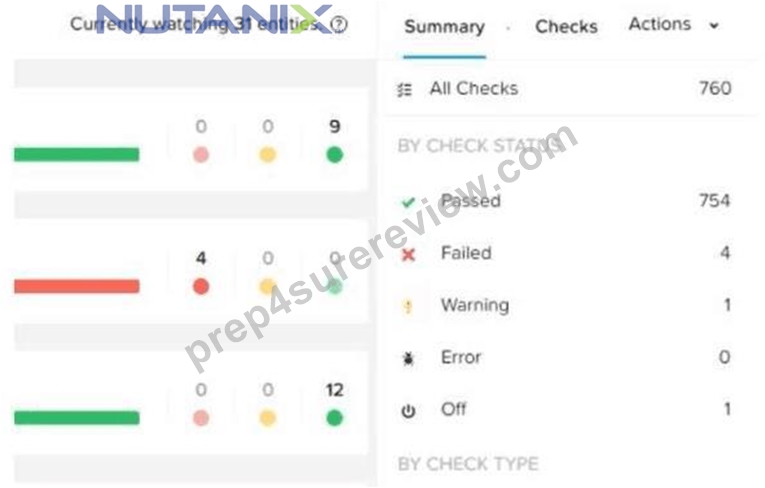
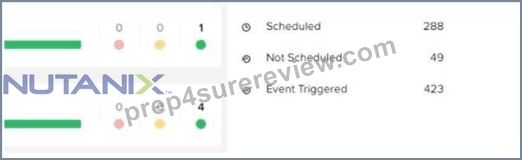
What should be first selected to run a full health check?
- A. Failed
- B. Checks
- C. Actions
- D. Scheduled
Answer: C
Explanation:
To run a full health check in Prism Element, the administrator should first select theActionsmenu. From there, the administrator can choose to execute health checks for the entire cluster or specific components. This ensures a comprehensive evaluation of the cluster's health.
Other options:
* Scheduled: Refers to predefined or automated health checks.
* Checks: Displays the list of checks but doesn't initiate them.
* Failed: Filters checks based on their status but doesn't start a new check.
References:
Nutanix Cluster Health Documentation.
Nutanix Prism Element User Guide - Health Check Procedures.
NEW QUESTION # 22
How can an administrator work with Nutanix Support to recover a deleted VM, in its most up-to-date status, within a 24-hour period of the VM being deleted?
- A. Use NC2 on AWS.
- B. Use third party tools.
- C. Use Nutanix Recovery Plan.
- D. Use the Recycle Bin.
Answer: D
Explanation:
The correct answer isB. Use the Recycle Bin.
TheRecycle Binfeature in Nutanix enablessoft deletion of VMs, where the deleted VM is retained in a non- visible state for24 hoursby default before being purged. During this retention window:
* NutanixSupportcan assist in recovering the VM in itsmost up-to-date state.
* No snapshots or backups are required for this recovery mechanism.
* TheRecycle Bin is enabled by defaultin recent AOS versions.
UI Path (for visibility):
This functionality is internal and requires Support engagement for recovery.
Clarification:
* A (Nutanix Recovery Plan):Used with NearSync or Async DR; does not recover recently deleted VMs automatically.
* C (NC2 on AWS):Disaster recovery infrastructure, not applicable to local deleted VM recovery.
* D (Third-party tools):Irrelevant to Nutanix native functionality.
Official Reference:
* Nutanix Administration Guide - VM Recovery using Recycle Bin
* Excerpt: "Deleted VMs can be recovered by Nutanix Support within 24 hours using the Recycle Bin soft-delete capability."
NEW QUESTION # 23
At what time does LCM auto-inventory run by default?
- A. 1:00am
- B. 4:00am
- C. 2:00am
- D. 3:00am
Answer: C
Explanation:
By default, Nutanix Lifecycle Manager (LCM) auto-inventory runs at2:00 AMlocal cluster time. LCM performs a daily check to gather information about available updates for firmware, software, and other components to ensure the cluster remains up-to-date. This operation is non-disruptive and does not impact cluster performance.
:
Nutanix Lifecycle Manager (LCM) Documentation - Default Settings.
Nutanix Support Portal - LCM FAQ.
NEW QUESTION # 24
An administrator needs to implement a disaster recovery plan. The company has two sites, each with its own Nutanix AHV cluster. Latency between the sites is 30ms.
Which built-in functionality in Prism Element could the administrator use to enable disaster recovery between the two clusters?
- A. Data Protection
- B. Metro Cluster
- C. Recovery Plan
- D. Protection Policies
Answer: B
Explanation:
TheData Protectionfeature in Prism Element provides built-in disaster recovery capabilities by enabling asynchronous replication between Nutanix clusters. With a latency of 30ms between the two sites, asynchronous replication can ensure that data is replicated efficiently while adhering to recovery point objectives (RPO). The administrator can configure Protection Domains and Replication Targets to set up DR between the clusters.
* A. Recovery Plan:Incorrect, as Recovery Plans are part of Prism Central for orchestrated failover, not Prism Element.
* B. Protection Policies:Incorrect, as these are defined under Prism Central.
* C. Data Protection:Correct, as it enables disaster recovery via replication configurations in Prism Element.
* D. Metro Cluster:Incorrect, as Metro Cluster requires low latency (<5ms) and is not suitable for a
30ms latency scenario.
References:
Nutanix Data Protection and Disaster Recovery Guide.
Nutanix Bible: Data Protection Overview.
NEW QUESTION # 25
An administrator is configuring Erasure Coding on a Redundancy Factor 2 cluster.
How many nodes, at a minimum, are necessary?
- A. 0
- B. 1
- C. 2
- D. 3
Answer: B
Explanation:
For a cluster withRedundancy Factor 2 (RF2), at least4 nodesare required to configure Erasure Coding.
Erasure Coding (EC) distributes data and parity across nodes to improve storage efficiency while maintaining data protection. RF2 requires a minimum of 4 nodes to ensure sufficient space for data and parity distribution.
Other options:
* 3 nodes: Insufficient for EC with RF2.
* 5 and 6 nodes: Can support EC, but the minimum requirement is 4.
:
Nutanix Administration Guide - Erasure Coding Configuration.
Nutanix Storage Concepts Documentation.
NEW QUESTION # 26
Which Nutanix Support case priority level indicates that the system is available but experiencing issues that directly impact productivity?
- A. P1
- B. P4
- C. P2
- D. P3
Answer: D
NEW QUESTION # 27
When is deduplication recommended?
- A. Server workloads
- B. Linked Clone VMs
- C. Full clone VMs
- D. Cold data
Answer: A
NEW QUESTION # 28
An administrator would like to configure a cluster to perform an LCM inventory automatically.
At what frequency will the inventory run by default?
- A. Every 8 hours
- B. Every 4 hours
- C. Every 24 hours
- D. Every 12 hours
Answer: C
Explanation:
The correct answer isD. Every 24 hours.
In NutanixLife Cycle Manager (LCM), when theLCM Auto Inventoryfeature is enabled, the system performsautomatic inventory scansof the cluster's hardware and software components. By default, thisauto- inventory runs every 24 hoursto keep track of firmware, software versions, and available updates.
Clarifications:
* The frequency isnot user-configurablefrom the Prism UI.
* It ensuresaccurate detection of upgrade eligibilityand component compliance.
* The admin can alsorun an inventory manuallyat any time.
Prism UI Navigation Path:
Settings > LCM > Auto Inventory(toggle enabled)
Official Reference:
* Nutanix LCM Guide - Auto Inventory Section
* Excerpt: "When Auto Inventory is enabled, LCM automatically performs inventory every 24 hours."
NEW QUESTION # 29
A Veeam Backup appliance, which uses iSCSI, must be deployed into an AHV-based cluster.
What must be configured to allow Veeam to connect to the Nutanix cluster?
- A. Nutanix Objects
- B. Prism Central
- C. Data Services IP
- D. Network Segmentation
Answer: C
NEW QUESTION # 30
When configuring a physical network switch in Prism Element, what information is required?
- A. SMTP Configuration
- B. SNMP Configuration
- C. NTP Configuration
- D. DNS Configuration
Answer: B
Explanation:
When configuring a physical network switch in Prism Element,SNMP Configurationis required to enable monitoring and communication between the Nutanix cluster and the network switch. SNMP (Simple Network Management Protocol) is used to gather metrics and detect issues such as link failures or performance bottlenecks, ensuring the cluster operates efficiently with the physical network infrastructure.
:
Nutanix Network Management Guide - SNMP Configuration.
Nutanix Administration Guide - Configuring Switches for Monitoring
NEW QUESTION # 31
What minimum number of clusters must be registered to Prism Central to open a support case from the UI?
- A. 0
- B. 1
- C. 2
- D. 3
Answer: A
Explanation:
The correct answer isB. 1
Nutanix Prism Central provides the ability to create and manage support casesdirectly from the UI, but this functionality requiresat least one clusterto be registered to Prism Central. The Support option becomes active onceone or more clustersare managed.
Important distinctions:
* Zero clusters(Option A): With no clusters registered, Prism Central is effectively disconnected from any environment and thus cannot associate logs or telemetry with a support case.
* One cluster(Option B): Enables access to support features, including log bundle generation and direct case submission.
* Options C and D (2 or 3 clusters) are incorrect; they arenot a requirementfor enabling support case functionality.
Prism Central UI Navigation Path:
Settings (gear icon) > Support > Create Support Case
Official Reference:
* Nutanix Prism Central Guide - Support Integration Section
* Excerpt: "To open a support case through Prism Central, ensure at least one cluster is registered.
Support features become available once a cluster is connected."
Conclusion:Only one cluster is required to activate the support case workflow in Prism Central.
NEW QUESTION # 32
An administrator has spent time correcting specific issues that have been identified by NCC Health Checks in Prism Element.
How can just the checks that previously did not pass be executed again to confirm they are all resolved?
- A. Run ncc health checks run_all.
- B. Select Run Check for each check worked.
- C. Run LCM Pre-Upgrade to trigger NCC Checks.
- D. Select Only Failed And Warning Checks.
Answer: D
Explanation:
To rerun only the health checks that previously failed or issued warnings, the administrator can select theOnly Failed and Warning Checksoption in Prism Element. This targeted approach helps verify that resolved issues have been addressed without rerunning all checks unnecessarily.
Steps:
* Navigate toPrism Element > Health > NCC Checks.
* Filter forOnly Failed and Warning Checksand rerun them.
Other options:
* A. Run LCM Pre-Upgrade: Runs pre-upgrade checks, not related to health check validation.
* B. Runncc health_checks run_all: Executes all checks, not just failed ones.
* C. Select Run Check for each check worked: Requires manual execution for each check.
References:
Nutanix Administration Guide - Health Checks.
Nutanix Cluster Check (NCC) Documentation.
NEW QUESTION # 33
When using the LCM Dark Site procedure in Prism Element or Prism Central, which Nutanix software component should be checked and upgraded first?
- A. Foundation
- B. LCM Framework
- C. MSP
- D. NCC
Answer: B
NEW QUESTION # 34
Nutanix Support has asked an administrator to provide an NCC output, but there is no access to the command line.
What should the administrator do to provide the requested NCC output?
- A. Run Health Checks in the Event Dashboard.
- B. Configure email in Alert Settings and Run Health Checks in the Health Dashboard.
- C. Run Health Checks in the Alert Dashboard and enter an email to send it to.
- D. Configure email in Alert Settings and Run Health Checks in the Alert Dashboard.
Answer: B
Explanation:
When command-line access is unavailable, Nutanix administrators can use the Prism UI to generate an NCC (Nutanix Cluster Check) output. The steps are:
* Configure the email settings inAlert Settingsunder the Prism UI.
* Navigate to theHealth Dashboard, where the "Run Health Checks" option can be used.
* Provide the administrator's email address to send the health report, which includes NCC outputs.
This method enables the administrator to share diagnostic information with Nutanix Support directly via email.
* A. Run Health Checks in the Alert Dashboard and enter an email to send it to:Incorrect. Health Checks are run from the Health Dashboard, not the Alert Dashboard.
* B. Configure email in Alert Settings and Run Health Checks in the Health Dashboard:Correct.
This provides the requested NCC output when the command-line is inaccessible.
* C. Run Health Checks in the Event Dashboard:Incorrect. Health Checks are not run from the Event Dashboard.
* D. Configure email in Alert Settings and Run Health Checks in the Alert Dashboard:Incorrect, as this is not the correct location for Health Checks.
References:
Nutanix Administration Guide: Health Dashboard and NCC.
Nutanix Support Knowledge Base Article on Sending NCC Reports Without CLI Access.
NEW QUESTION # 35
An administrator has spent time correcting specific issues that have been identified by NCC Health Checks in Prism Element.
How can just the checks that previously did not pass be executed again to confirm they are all resolved?
- A. Run ncc health checks run_all.
- B. Select Run Check for each check worked.
- C. Run LCM Pre-Upgrade to trigger NCC Checks.
- D. Select Only Failed And Warning Checks.
Answer: D
NEW QUESTION # 36
......
NCA-6.10 Dumps Ensure Your Passing: https://dumpstorrent.prep4surereview.com/NCA-6.10-latest-braindumps.html
